

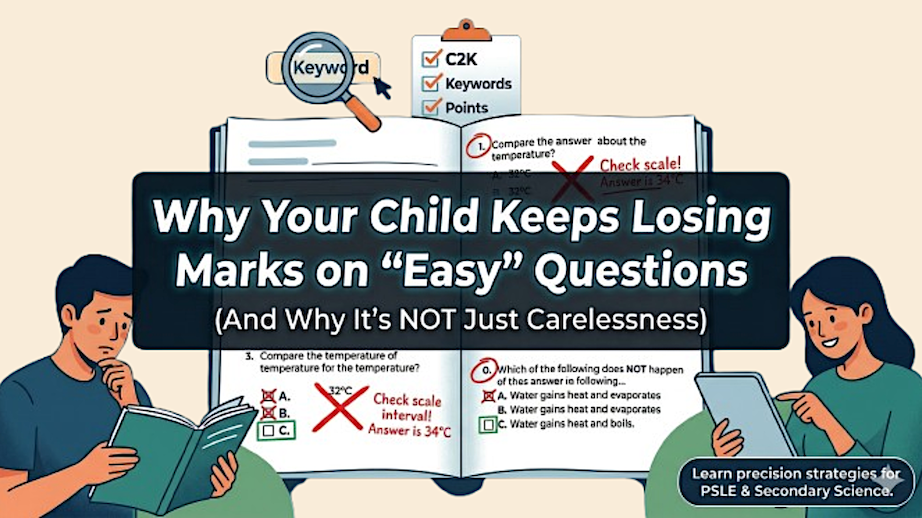
(And Why “Be More Careful” Is Useless Advice)
You’ve seen the paper. You’ve had the talk.
“You knew this concept! Why did you lose 2 marks here?”
And the standard reply?
“Oh, I was just careless.”
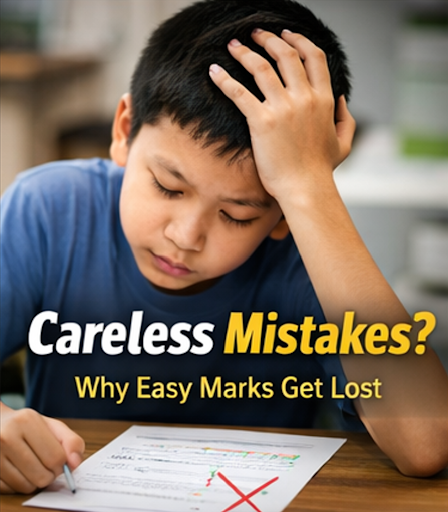
In the Singapore Science syllabus, “carelessness” is the silent grade-killer. 2 marks lost in Section A, 2 marks leaked in Section B for missing keywords… suddenly, an AL1 slides to an AL3, or a B3 becomes a C5.
But here’s the hard truth: Careless mistakes are not random accidents. They are technical flaws in your child’s answering system.
The Hidden Problem: Precision vs. Understanding
When children lose marks on “easy” questions, we assume:
- They weren’t paying attention
- They were rushing
- They didn’t try hard enough
In Science, most children:
- Do understand the concept (e.g., they know how evaporation works).
- Do want to do well.
- But they fail to translate their thoughts into the specific keywords markers demand.
In the Singapore context, “carelessness” is usually one of three systemic failures:
- The Context Gap: They explain the theory but forget to link it back to the specific objects in the diagram.
- The Keyword Phobia: They use “common sense” language instead of scientific terminology (e.g., saying “the water disappeared” instead of “evaporated into water vapour”).
- The Comparison Trap: Forgetting to use comparative adjectives (higher, faster, more) in “Compare” questions.

Why This Matters in the PSLE/Secondary Era
The Singapore Science paper is designed to reward precision, not just “effort.”
- One “NOT” missed in an MCQ (e.g. “Which of the following is NOT…”) = 2 marks gone.
- One missing link in a “Cause and Effect” open-ended answer = 0 marks for the entire section.
- Confusing “Mass” with “Weight” or “Volume” = Pointless marks lost.
If your child is a “strong” student who keeps plateauing at the same grade, they don’t need more content, they need Precision Training.
The Powerplay Strategy: 3 Ways to Stop the Leak
Strategy #1: Kill the “Speed-Reading” Habit
Most Science mistakes happen in the first 10 seconds. Students see a familiar diagram (like a circuit or a plant cell) and assume they know the question.
- The Fix: Use the C2K (Context-to-Keyword) approach.
- The Action: They must circle the “Command Word” (Identify, Explain, Compare) and underline the “Conditions” (e.g., “in the dark,” “sealed container”). This forces the brain to process the constraints before jumping to the answer.
Strategy #2: Audit the “Check”
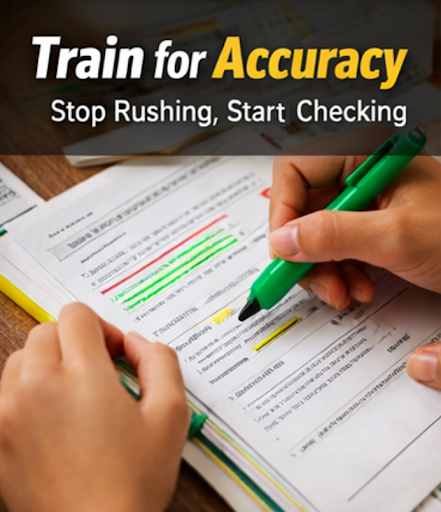
Telling a child to “check your work” is vague. They usually just stare at the page until the timer runs out.
- The Fix: Give them a Precision Checklist specifically for Science:
- Comparison: If there are two setups, did I mention both?
- Keywords: Did I use the “Must-Have” words for this topic (e.g., heat lost, heat gain, exposed surface area)?
Turn checking into a routine, not a guess.
Strategy #3: Categorize Mistakes (The “Error Audit”)
During home practice, don’t just mark the answer wrong and move on.
- The Shift: Identify the type of error.
- Type A (Content): Truly didn’t know the topic. (Needs more study)
- Type B (Technique): Knew it, but phrasing was “weak.” (Needs C2K training)
- Type C (Execution): Bubbled the wrong MCQ or missed a “NOT.” (Needs “Slow-Down” drills)
The Real Difference
| Without Precision Training | With Powerplay Training |
| Rushes to finish the paper | Reads with the “Marker’s Lens” |
| Uses “common sense” language | Uses specific MOE keywords |
| Repeats the same “silly” mistakes | Audits their own work for “traps” |
| Effort > Results | Precision = AL1/A1 |
Conclusion
If your child is losing marks on “easy” questions, they aren’t lazy. They just haven’t been taught how to handle the high-pressure precision that Singapore Science demands.
The good news? Precision is a skill. And like any skill, it can be mastered.
Stop leaving your child’s Science grades to “luck.”
👉 Follow us for more direct, no-nonsense strategies to bridge the gap between “knowing Science” and “scoring in Science.”

Responses