

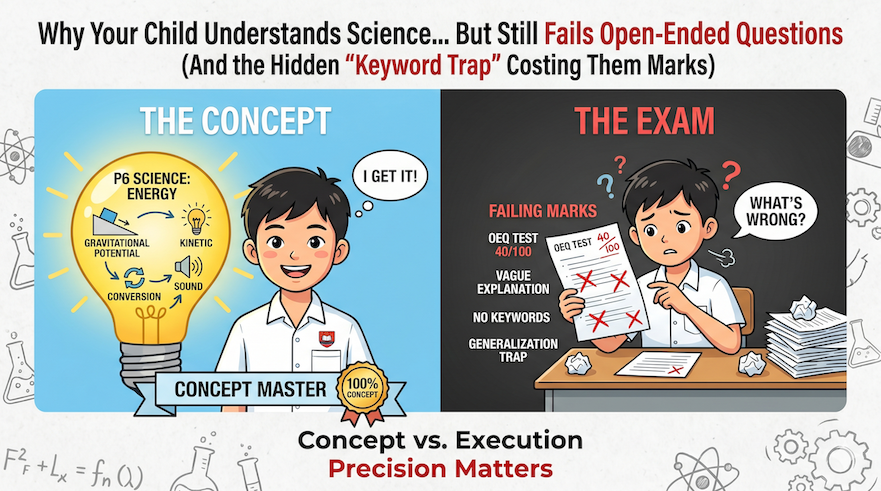
(And the Hidden “Keyword Trap” Costing Them Marks)
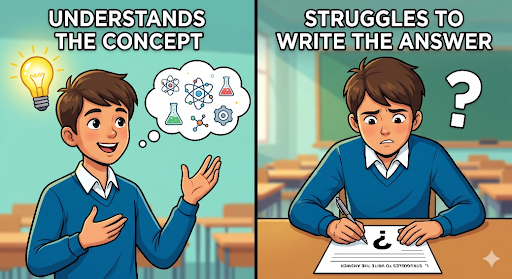
Your child studies hard. They understand the topic. They can explain it to you at home and they get the MCQs correct.
But when it comes to Open-Ended Questions (OEQs)? The marks just aren’t there. The feedback is always the same:
- “Incomplete answer”
- “Missing keywords”
- “Not specific enough”
It’s frustrating because you know your child understands the concept. So what’s going wrong?
The Brutal Truth: Understanding NOT EQUAL to Scoring
In PSLE Science, understanding is only half the equation. You can understand why a ball rolls down a hill, but if you don’t use the specific vocabulary MOE requires, you get zero marks.
PSLE Science is a test of precision, not just “getting the idea.”
The “Keyword Trap” That Most Students Fall Into
Many students write answers that are conceptually correct and logically sound, but they use “everyday English” instead of “Scientific language.”
The Common Failure (P6 Energy Topic)
Question: A wooden block is released from the top of a ramp. It slides down and hits a bell. Explain why the bell rings.
Child’s answer: “The block has energy at the top. When it slides down and hits the bell, the energy makes a sound.”
Verdict: 0 Marks.
- The Issue: “Energy” is too vague. “Makes a sound” is not a scientific process.
- Missing Keywords: Gravitational Potential Energy, Kinetic Energy, Converted, Transferred
What the Examiner Is Actually Looking For
MOE examiners mark based on a strict rubric. They aren’t looking for a story; they are looking for:
- Specific Scientific Keywords (e.g., Converted, Transferred, Rate of)
- Clear Logical Links (Cause and effect)
- Application to the Context (Using names of objects from the question)
No Keywords = No Evidence = No Marks.
The Real Solution: Mastering the “PowerPlay CER”
At PowerPlay Edu Lab, we use the CER (Claim, Evidence, Reasoning) method. But we don’t just use it as a checklist; we use it to build “water-tight” answers.
Let’s fix the “Bell” question using CER:
| Step | Focus | The Model Answer |
| Claim | The Answer | The bell rings because the kinetic energy of the block was converted into sound energy. |
| Evidence | The Setup | The block at the top of the ramp possessed Gravitational Potential Energy. |
| Reasoning | The Science | As the block slid down, its GPE was converted into Kinetic Energy. When the block hit the bell, some of that Kinetic Energy was transferred to the bell and converted into Sound Energy. |
Now the answer is complete, scientific, and 100% mark-worthy.
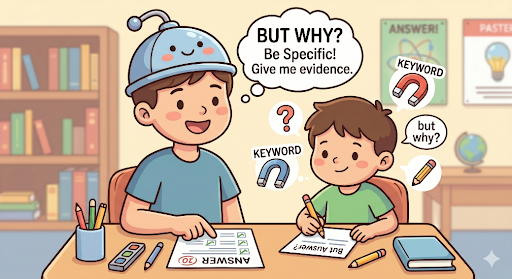
How Parents Can Help at Home
You don’t need to be a Science expert to support your child. Try these three checks:
- The “So What?” Test:
If they say “Material X is a poor conductor of heat,” ask them “So what?” Force them to link it to the outcome (e.g., “…so the hand loses heat to the material slower”). - Ban the word “It”:
If they write “It flows down,” make them replace “It” with the specific subject (e.g., “The water”). Precision matters. - Practice Writing, Not Just Talking:
Many children can verbalize the answer but struggle to write the logical sequence. PSLE is a written paper—the pen must match the brain.
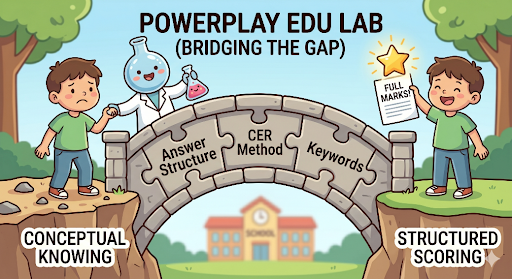
Bridging the Gap at PowerPlay Edu Lab
This is where many students struggle: they have the knowledge, but they can’t translate it into “Examiner Language.”
At PowerPlay Edu Lab, we focus on bridging this gap. We help students connect conceptual understanding with structured answering techniques. Because in PSLE Science, it’s not just about knowing the answer—it’s about answering in a way that earns marks.
Conclusion
If your child is struggling with OEQs, it doesn’t mean they aren’t smart or didn’t study. It means they haven’t been taught the “code” to unlock the marks. Once they learn to use CER with precision, their confidence improves and their marks finally reflect their true ability.
👉 What’s App us if you want to find out more about our classes.

Responses