

(And the Missing Link Between Your Child’s Revision and Their AL Grade)
Your child studied.
They memorised the definitions.
They highlighted the textbook until it was neon yellow.
They even recognised the topic the moment they opened the paper.
But then, the results came back.
“Concept correct, but no marks.”
“Vague answer.”
“Missing keywords.”
If your child is working hard but the marks aren’t moving, it’s not a memory problem. It’s a thinking problem.

The Reality: The PSLE “Curveball”
Many students prepare for Science by:
- Memorising “Model Answers” from top-school papers.
- Spotting “Standard Questions.”
- Repeating keywords like a mantra.
This worked 10 years ago. But today’s MOE Science papers are designed to be “template-proof.” The examiners aren’t testing what your child can repeat; they are testing how your child can apply concepts to weird, real-life scenarios they’ve never seen in a textbook.
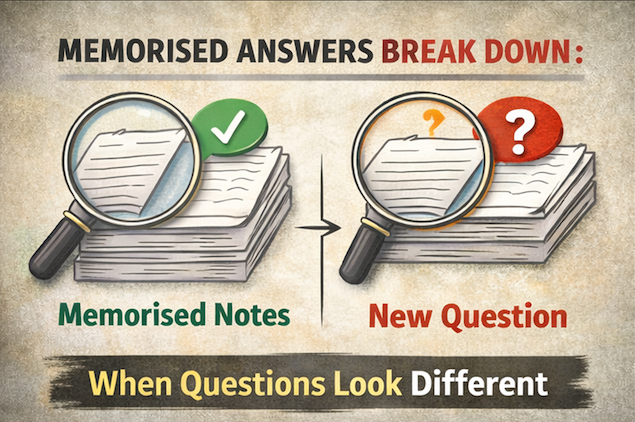
Why Memorisation Fails in Section B
Memorisation is rigid. The PSLE is fluid. When a question is:
- Reworded (using “State” instead of “Explain”).
- Combined (mixing Heat Energy with Water Cycle).
- Contextualised (asking about a specific Dyson-style fan or a new solar panel design).
…the memorised “template” fails. Your child freezes because the question doesn’t look like the one in their assessment book.
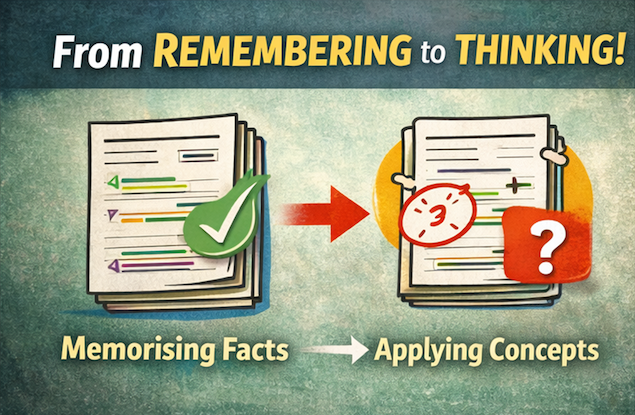
3 Strategies to Move from “Regurgitating” to “Thinking”
1. Focus on the “Cause & Effect” Chain
In the PSLE, an answer is only as good as its logic. Students often jump to the conclusion without showing the steps.
- The Old Way: Memorising “Dark surfaces absorb heat faster.”
- The “Thinking” Way: Ask your child, “If I paint half this box black and half white, what happens to the air particles inside? Why?”
- The Goal: Train them to see Science as a chain of events, not a list of facts.
2. Use the “Context-to-Keyword” (C2K) Bridge
Parents often ask: “My child knows the science, so why did they miss the keyword?” It’s because they don’t know how to link the Context (the specific experiment in the question) to the Keyword (the scientific principle).
- Try This: When doing past-year papers, don’t let them write the full answer yet. Ask them: “What is the ‘clue’ in this diagram? What ‘Topic’ is it actually testing?”
3. The “Teacher” Test
If your child can’t explain a concept to you in simple English, they don’t understand it well enough to write it in “Science English.”
- Try This: Have them teach you a concept using a real-life example from your kitchen or garden. If they stumble, that’s exactly where they would have lost marks in Section B (OEQ).
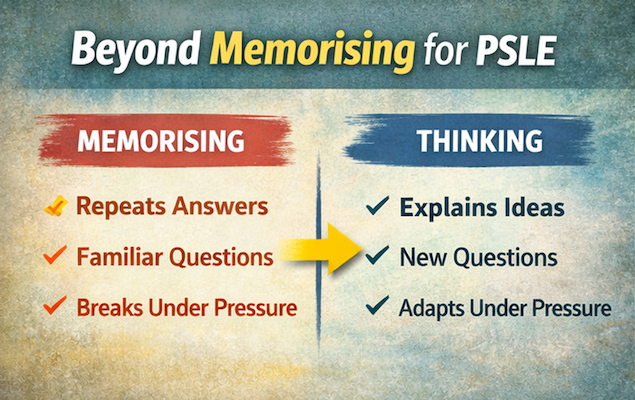
The Bottom Line: Thinking vs. Repeating
| The “Memoriser” | The “Thinker” |
| Panic when a question looks “new.” | Calmly breaks down the clues. |
| Uses keywords in the wrong places. | Links keywords to the specific context. |
| Struggles with 3-mark “Explain” questions. | Structures answers with clear logic. |
In the PSLE, the Thinker wins every time.
Conclusion
If your child is stuck in the “Memorisation Trap,” it’s a frustrating place to be. They are putting in the effort, but seeing zero ROI on their marks.
To succeed in today’s Science syllabus, they need to stop treating Science like History. They don’t need more notes; they need a Thinking Technique.
At Powerplay Edu Lab, we don’t just give students the answers. We teach them the Thinking Technique to decode any question, no matter how many “twists” the examiners throw at them. We bridge the gap between knowing the Science and scoring the Mark.
We don’t teach students to memorise. We teach them to think. Slots at Powerplay Edu Lab are limited to parents who are ready to move beyond rote learning and see real conceptual mastery.
[Message us to check availability]
P.S. We also address exam anxiety and performance blocks using the MAP Method—because a brilliant mind can’t perform if it’s stressed.

Responses