

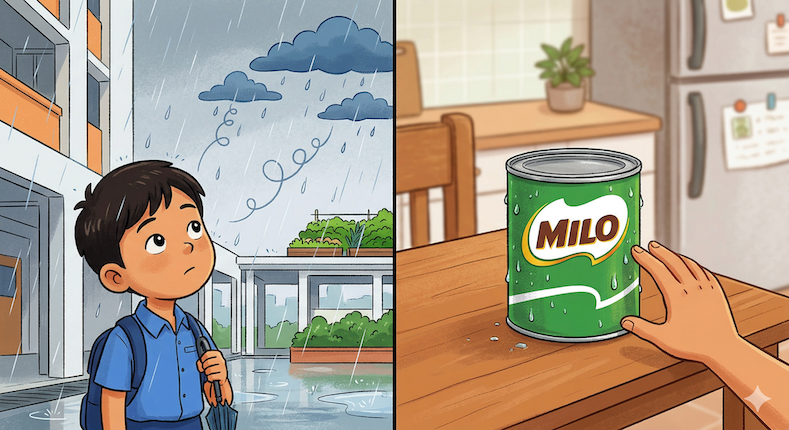
Have you ever wondered why the rain never runs out?
Or why your Milo tin gets “sweaty” when you take it out of the fridge?
It’s all part of a never-ending journey called the Water Cycle!
In the Singapore Primary 5 Science syllabus, we need to understand how water changes its state and how the Sun powers this whole process.
Before we start, let’s watch this quick video lesson or scroll down to read further.
Rain doesn’t just come out of nowhere. Water is always moving around Earth in a continuous process called the water cycle.
But how does water travel from the ground to the sky and back again?
Water Exists in Three States
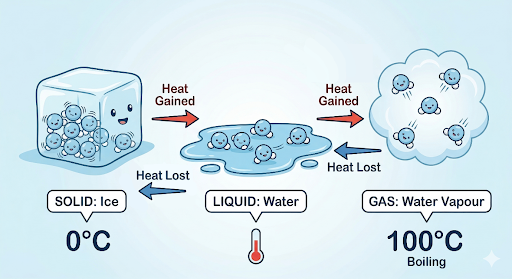
Water is special because it can exist in three different states:
- Solid – Ice
- Liquid – Water
- Gas – Water vapour
Key Rule: For water to change its state, it must either Gain Heat or Lose Heat.
How Water Changes Form
To score in your Science exams, you must know these processes and their temperatures:
- Melting (Solid → Liquid): Ice gains heat and turns into water at 0°C.
- Boiling (Liquid → Gas): Water gains heat and turns into steam at 100°C.
- Evaporation (Liquid → Gas): This happens at any temperature below 100°C. It’s why your PE attire dries in the sun!
- Condensation (Gas → Liquid): Water vapour loses heat to a cooler surface and turns into droplets.
- Freezing (Liquid → Solid): Water loses heat and turns into ice at 0°C.
The 4 Stages of the Water Cycle
The Sun is the “battery” that powers this entire cycle. Without the Sun’s heat, the cycle stops!
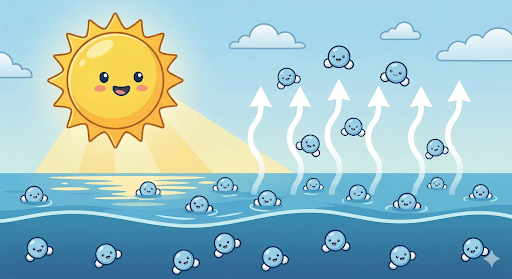
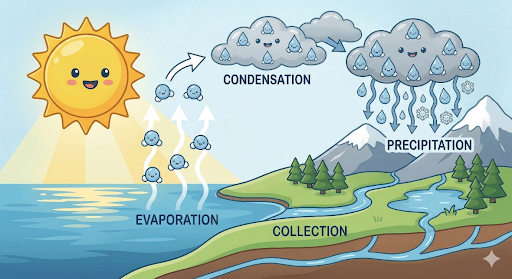
Stage A: Evaporation (The Great Escape)
The Sun heats up the water in our reservoirs and oceans. The liquid water gains heat and turns into water vapour.
- Factors that make it faster: Higher temperature, more wind, humidity and a larger exposed surface area (e.g., spreading your clothes out instead of bunching them up!).
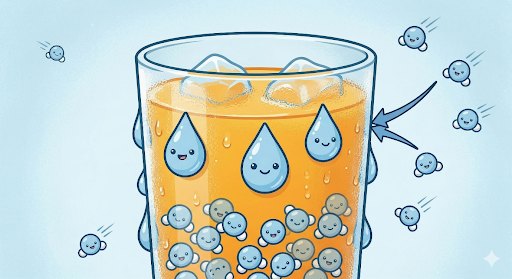
Stage B: Condensation (Cloud Making)
As water vapour rises high into the sky, it meets cooler air. It loses heat and turns back into tiny water droplets. These droplets huddle together to form clouds.
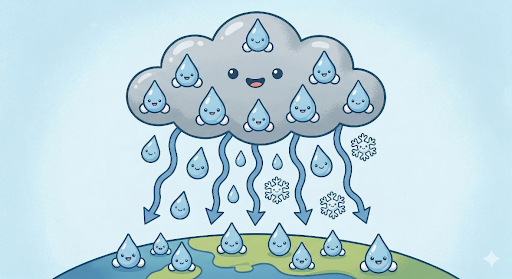
Stage C: Precipitation (Coming Down)
When the clouds get too heavy with water droplets, they fall back to Earth as rain (or snow/hail in colder countries).
Stage D: Collection (The Restart)
Rainwater flows into the ground and back into our oceans and rivers. Then, the Sun starts the whole process all over again!
Why Is the Water Cycle Important?
The water cycle is essential because:
- It recycles water on Earth
- It provides fresh water for plants, animals, and humans
- It helps maintain weather and climate
Without the water cycle, life on Earth cannot survive.
Water Pollution and Its Impact
Water is a limited natural resource, and pollution can harm it.
Water pollution:
- Makes water unsafe for drinking
- Harms aquatic plants and animals
- Disrupts the water cycle
We must protect our water by:
- Not littering
- Reducing waste
- Using water responsibly
Investigating Water Changes
Scientists study water by observing how it changes with heat.
For example:
- Ice melts at 0°C
- Water boils at 100°C
We can also investigate how fast water evaporates by changing:
- Wind
- Temperature
- Surface area
- Humidity
In Conclusion…
- Water exists in three states:
- Solid
- Liquid
- Gas
- Water changes state through:
- Melting
- Freezing
- Evaporation / Boiling
- Condensation
- The water cycle includes:
- Evaporation
- Condensation
- Precipitation
- Collection
- The water cycle is essential for life on Earth
- We must protect water resources
Have you learned something new?
Ready to test what you know?
Click here to grab your FREE Primary 5 Water Cycle Worksheet!

Responses