

(And How to Spot Them Before Your Child Loses Marks)
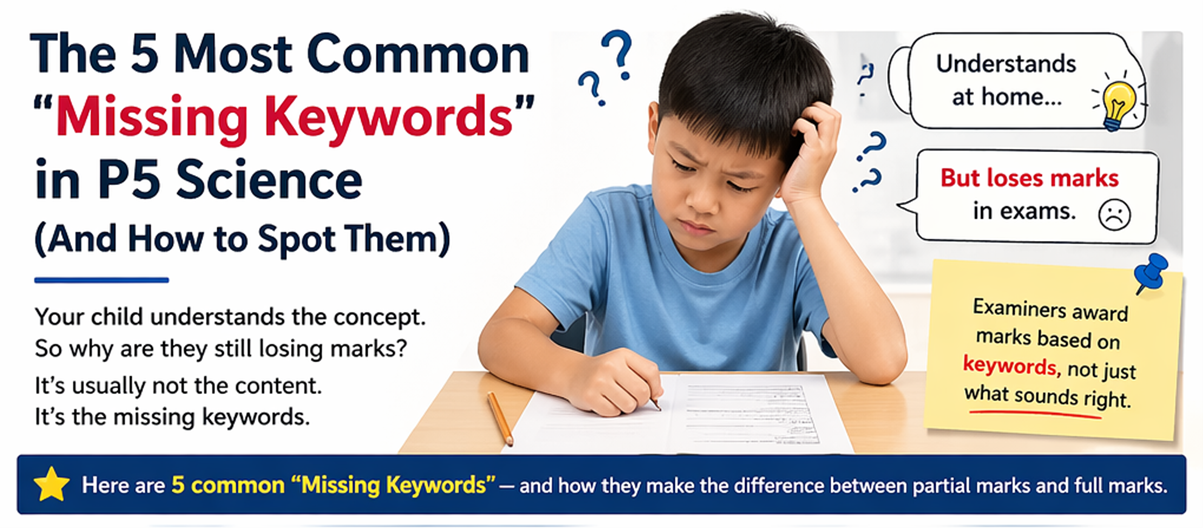
Your child understands the topic. They can explain it to you at home. They revise consistently.
But when the exam papers come back? They are still losing marks on Section B Open-Ended Questions (OEQ).
It’s incredibly frustrating. The issue usually isn’t a lack of studying or conceptual understanding. It’s the missing keywords.
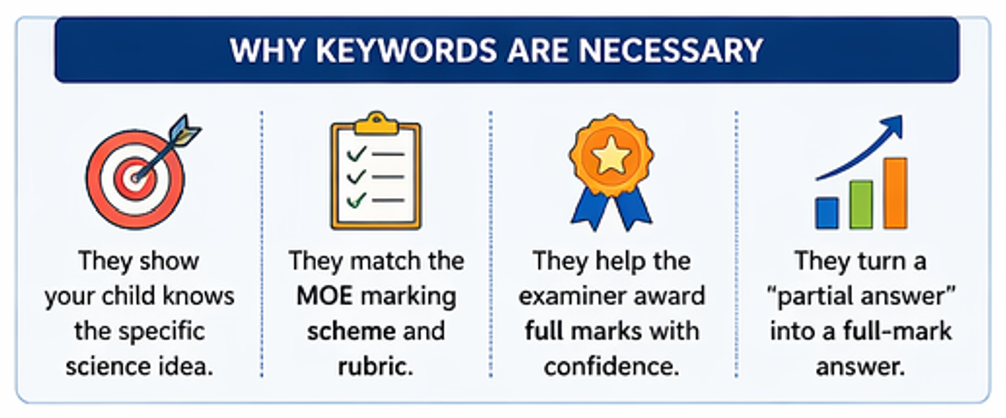
In the Singapore MOE Primary Science syllabus, examiners don’t award marks for answers that just “sound right.” They mark against strict, specific rubrics. Without precise scientific language, your child’s answer sounds vague—and vague answers mean dropped marks.
At Powerplay Edu Lab, we use The Thinking Technique to help students bridge this exact gap. Let’s look at the 5 most common types of missing keywords that cause P5 students to lose marks, using actual P5 syllabus topics.
1. Process Words
These are words that describe a specific state of change or biological action.
- The P5 Mistake (Topic: Water Cycle):
- Question: Explain how clouds are formed.
- Typical Student Answer: Water from the sea goes up into the sky and turns into clouds. ❌
- What’s missing: Evaporates, water vapour, condenses.
- MOE-Approved Answer: Liquid water gains heat from the Sun and evaporates into water vapour. The warm water vapour rises, loses heat to the cooler surrounding air, and condenses into tiny water droplets, which gather to form clouds. ✅
2. Energy Words
P5 Science requires students to track energy states, forms, and transfers precisely.
- The P5 Mistake (Topic: Electricity / Forms of Energy):
- Question: What happens to the energy when a bulb lights up in a closed circuit?
- Typical Student Answer: The battery gives power to the bulb so it lights up. ❌
- What’s missing: Chemical potential energy, electrical energy, converted.
- MOE-Approved Answer: The chemical potential energy stored in the battery is converted into electrical energy, which flows through the circuit and is further converted into light energy and heat energy in the bulb. ✅
3. Structure & Part Words
When dealing with Human or Plant Systems, students must pinpoint the exact structure responsible for a function.
- The P5 Mistake (Topic: Plant Transport System):
- Question: What happens to the plant if the outer ring of the stem containing the phloem is removed?
- Typical Student Answer: The food cannot go down to the bottom, so the roots die. ❌
- What’s missing: Phloem, transport, leaves to other parts.
- MOE-Approved Answer: The food-carrying tube is removed, so food made by the leaves cannot be transported downwards to the roots. The roots will starve and die. ✅
4. Comparison & State Terms
Science demands absolute precision. Using generic words like “air” instead of specific gases will instantly cost marks.
- The P5 Mistake (Topic: Human Respiratory System):
- Question: Compare the air a human inhales versus exhales.
- Typical Student Answer: We breathe in good air and breathe out bad air. ❌
- What’s missing: More/Less oxygen, carbon dioxide, percentage/amount.
- MOE-Approved Answer: Exhaled air contains less oxygen and more carbon dioxide than inhaled air. ✅
5. Linking Words (Cause & Effect)
A correct scientific term means nothing if it isn’t linked logically to a consequence. This is the heart of how to score full marks in science section B.
- The P5 Mistake (Topic: Cells / Reproduction in Plants):
- Question: Why must a seed absorb water before it germinates?
- Typical Student Answer: The seed needs water to grow. ❌
- What’s missing: So that, therefore, which allows (linking the water to the softening of the seed coat).
- MOE-Approved Answer: The seed absorbs water so that the seed coat softens, which allows the embryo to break through and emerge during germination. ✅
How Parents Can Help (Without Being Science Experts)
You don’t need a degree in science to upgrade your child’s exam performance. Use these three prompt questions at home:
- “Can you name the exact part or process?” (Change “water turning into gas” to evaporation).
- “What is the cause and effect?” (Force them to use linking words like as a result, therefore, or so that).
- “Are you using textbook language or conversational language?” (If it sounds like a casual chat, it won’t pass the marking rubric).
Master “The Thinking Technique” at Powerplay Edu Lab
If your child is struggling to adapt to the heavy demands of the Singapore MOE P5 science syllabus, they don’t need to memorize the entire textbook. They need a system.
At Powerplay Edu Lab, we teach students The Thinking Technique. We train kids to analyze the context of an exam question and extract the exact keywords required by the marking scheme dynamically—shifting them from understanding to scoring.
Don’t let missing keywords stand between your child and an AL1.

Responses