


And How to Rediscover the Wonder Behind the Worksheets
“Science used to be my favorite subject… until the tests started.”
If you are a parent in Singapore or following the rigorous Singapore Science curriculum, you have likely heard some version of this heartbreak.
When children are young, they are natural scientists. They bombard you with questions: Why is the sky blue? Why does ice melt? Why do shadows change shape? Everything is an open-ended exploration.
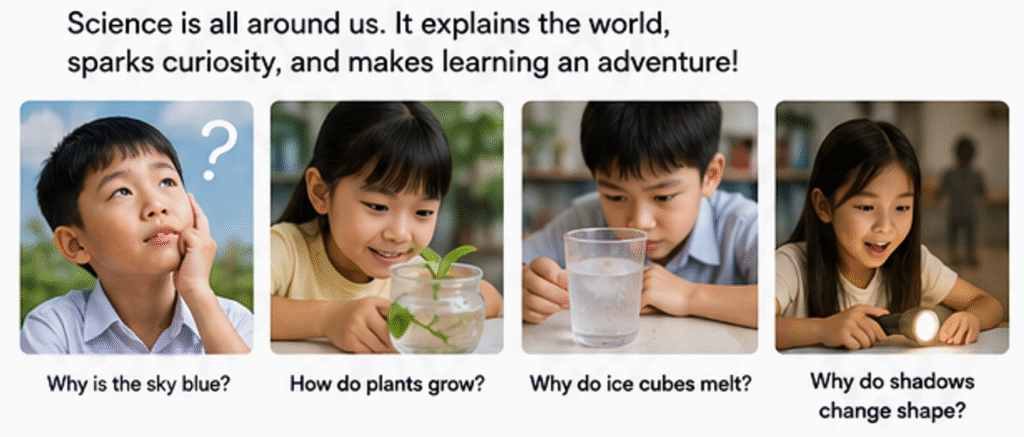
But somewhere around Primary 3, the magic shifts. Instead of discovery, Science suddenly becomes a mountain of:
- Endless revision cycles
- Rigid assessment books
- Stifling past-year exam papers
- The crushing anxiety of losing marks in Section B
Before long, the curiosity is replaced by dread. The child concludes, “I’m just not good at Science.”
But here is the truth: Science hasn’t changed. The way we force them to experience it has.
Science Was Never Meant to Live Inside a Textbook
One of the biggest mistakes we make is treating Science as a pure school subject. It isn’t. Science is simply the blueprint of how our world operates.
Your child is surrounded by it every single day:
- The condensation forming on their iced Milo cup.
- The rain evaporating off the HDB void deck or driveway.
- The heat transfer making a metal spoon hot in a bowl of soup.
These aren’t just topics to be memorized for a WA1 or WA2 exam; they are real-world experiences. When we strip the real world away and replace it with flat text on a page, we kill the desire to learn.
The Secret of High-Scoring Science Students
Many parents assume that the top students are simply the ones who can memorize the thickest stack of flashcards.
In reality, the strongest Science learners do something entirely different: They possess contextual curiosity.
Instead of blindly memorizing that “condensation occurs when warm water vapour touches a cooler surface,” they look at their cold drink on a hot Singapore afternoon and ask, “Where did that water on the outside actually come from?”
When a child understands the context, the concept sticks. And deep understanding lasts infinitely longer than temporary, stressful memorization.
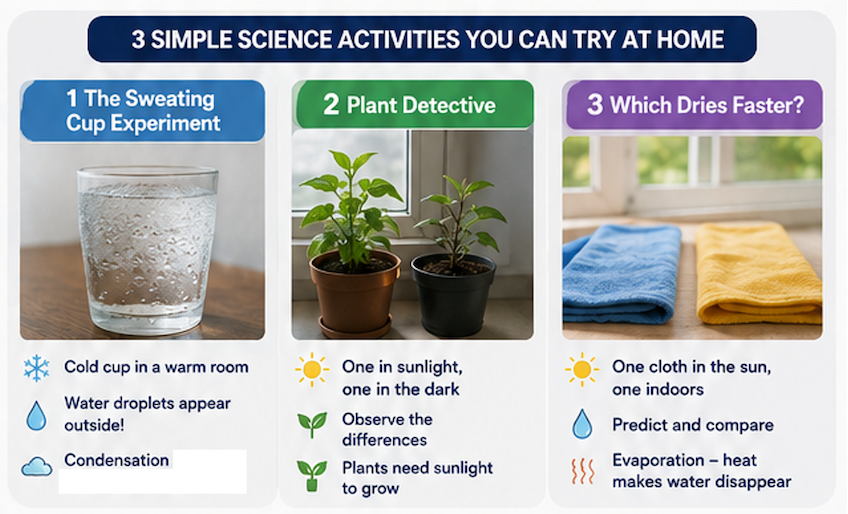
3 Low-Prep Experiments to Revive Their Curiosity Tonight
You don’t need an expensive laboratory setup to trigger this shift. You can do it in your kitchen using everyday items. Try these three simple activities to bridge the gap between abstract textbook concepts and reality:
1. The “Sweating” Cup (Topic: Cycles & Changes of State)
- What to do: Pour ice-cold water into a glass. Leave it on the kitchen table in a warm room for five minutes.
- The Lesson: Point out the droplets on the outside. Ask your child: “Did the water leak through the glass?” Watch their brain work as they realize the water came from the invisible water vapour in the air losing heat to the cooler outer surface of the glass.
2. The Window Plant Detective (Topic: Plant Systems)
- What to do: Take two small potted plants. Place one on the windowsill and one inside a dark cupboard for a few days.
- The Lesson: Observe the physical changes. This transforms a dry textbook diagram of photosynthesis into a living, breathing demonstration of a plant’s struggle for survival and its need for sunlight.
3. The Evaporation Race (Topic: Energy & Fair Testing)
- What to do: Wet two identical cloths. Hang one unfolded under the sun (or a bright balcony) and leave the other bunched up indoors. Predict which dries faster.
- The Lesson: This introduces Fair Testing—a massive component of Singapore Science exams. They learn how exposed surface area and presence of wind/heat affect the rate of evaporation, not through definitions, but through observation.
The Real Reason Kids Start to Dislike Science
It isn’t because the topics get boring. It’s because the exams get brutal.
The Singapore Science syllabus is world-renowned for a reason: it demands extreme conceptual precision. When children are constantly terrified of:
- Missing a single specific keyword and losing 2 marks.
- Failing to identify the “clues” in complex experimental setups.
- Running out of time in Section B (OEQ).
The pressure completely paralyzes their natural curiosity.
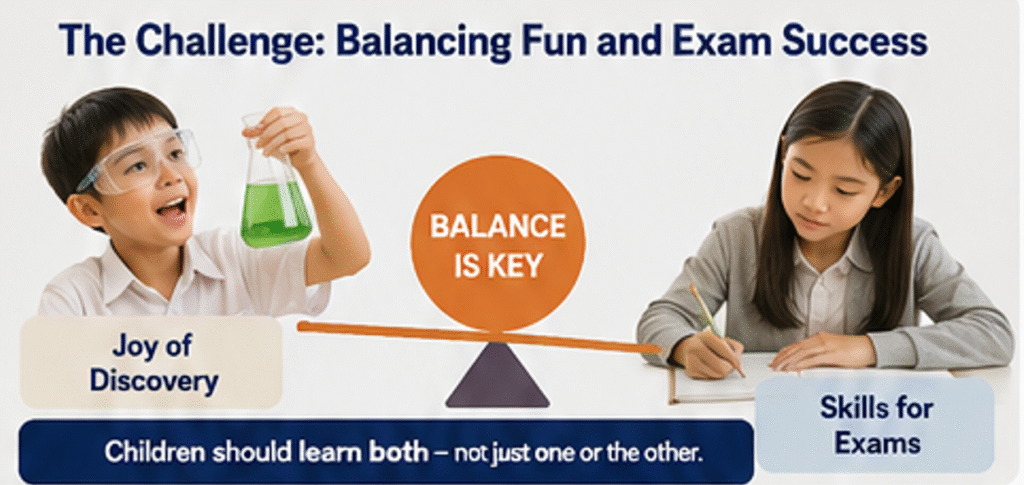
The Ultimate Challenge: Balancing Wonder with Exam Success
We cannot ignore the reality of grades. Exams matter, benchmarks matter, and your child absolutely needs to know how to score. They must master scientific keywords and know exactly how to structure an open-ended answer.
But focusing only on the exam strategies creates a fragile learner who panics the moment a question deviates from their assessment book.
The solution isn’t to choose between “Fun Science” and “Exam Science.” The solution is to merge them.
Children need to be taught:
- The joy of scientific discovery to build confidence.
- AND the precise analytical frameworks required to ace the paper.
How We Bridge the Gap at Powerplay Edu Lab
At Powerplay Edu Lab, we refuse to let worksheets kill the wonder of Science. But we also refuse to let our students walk into an exam unprepared.
We utilize The Thinking Technique to help students break down complex experimental questions without panic. Instead of forcing kids to blindly memorize paragraphs of text, we use CER method. We teach them how to look at a real-world scenario, extract the underlying scientific context, and seamlessly translate it into the exact keywords exam markers are looking for.
We don’t teach children to choose between loving Science and scoring an AL1 or A*. They can and should do both.
🤔 A Question for Tonight
The next time your child sighs over their Science homework and says, “I hate Science,” stop and ask them a gentle but crucial question:
“Do you hate Science… or do you just hate the exams?”
Almost always, it’s the exams.
Underneath the stress of the worksheets is a beautiful subject that explains everything from lightning bolts and magnets to how our own bodies breathe. When you help your child reconnect with that sense of wonder, the fear vanishes.
And the most surprising part? That is exactly when the top marks start rolling in.

Responses