


(And What High-Achieving Students Do Differently)
“My child sits at the study table for hours… so why are their Science results stuck?”
If you are a parent guiding your child through the rigorous Singapore Science syllabus, this script probably sounds intimately familiar:
- Hours spent hunched over heavy assessment books.
- Evenings spent highlighting textbooks until the pages are neon.
- Weekends packed with back-to-back tuition classes.
Yet, when the exam paper comes back, the marks don’t match the massive effort.
Naturally, our instinct as parents is to double down. “Maybe they just need more practice.” So we buy another stack of top-school past-year papers. We assign more worksheets. We demand more hours.
But what if the problem isn’t your child’s work ethic?
What if the problem is that traditional rote revision actively fails the demands of modern Science examinations?

The Dangerous Myth: More Hours = Better Results
Many people view academic preparation like filling a bucket: pour in more hours, get more marks. But the human brain—and the Ministry of Education (MOE) syllabus—does not work that way.
Consider two different students preparing for an Upper Primary Science paper:
| Student A (The Driller) | Student B (The Thinker) |
| Studies Science for 3 hours. | Studies Science for 1 hour. |
| Rereads notes and highlights definitions repeatedly. | Explains the underlying concept aloud in their own words. |
| Memorizes model answers from answer keys. | Dissects the experimental setup to find the “why.” |
| Focuses on finishing the worksheet. | Focuses on analyzing mistakes made in the worksheet. |
When exam day arrives and a brand-new, unseen experimental question appears in Section B, Student B consistently outperforms Student A.
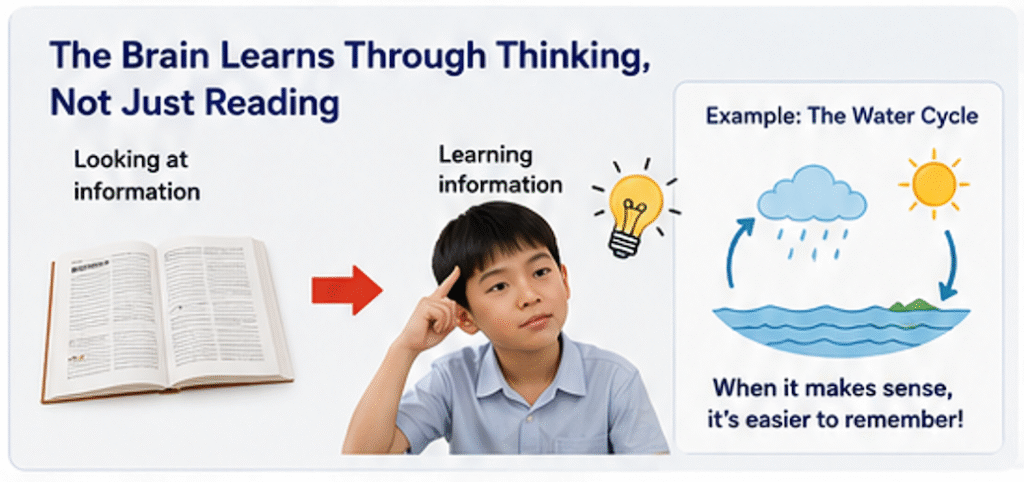
Why? Because Student A measured progress by time spent. Student B measured progress by cognitive engagement. The brain remembers what it processes, not what it looks at.
The Transition from Lower Primary to the P5/P6 Reality Check
In lower primary levels, basic memorization can sometimes squeeze out a passing grade. But once students hit Upper Primary (P5 and P6) and Lower Secondary, the game completely changes.
The exam is no longer testing: “Can you recite what you memorized?”
The exam is testing: “Can you identify the scientific principle hidden inside an unfamiliar scenario and apply it with precision?”
The Reality of Section B (OEQ): A student can memorize the definition of “evaporation” perfectly. But if they are handed a diagram of a customized solar still or a specific industrial cooling system and asked to explain the rate of condensation, memorized phrases fail. If they cannot bridge the context of the question to the required scientific keywords, they get awarded zero marks.
This is why endless drilling without strategy leads to burnout, not breakthroughs. They are building a massive library of facts but have no idea how to use the tools.
4 Signs Your Child is “Fake Studying” (Passive Learning)
Your child isn’t lazy; they might just be trapped in passive learning habits that yield zero return on investment. Watch out for these red flags:
- Warning Sign #1: The Rereading Loop. They read the same chapter four times but freeze when you ask them to explain the concept without looking at the book.
- Warning Sign #2: Model Answer Dependency. They memorize exact phrases from past top-school papers but panic the moment a question presents the same concept in a slightly different layout.
- Warning Sign #3: High-Volume, Low-Retention. They complete three exam papers back-to-back but cannot recall the core concepts or rectify their misconceptions three days later.
- Warning Sign #4: Erasing Without Learning. When corrections are given, they simply copy down the teacher’s correct answer without understanding why their original logic was flawed.
How to Shift from “Harder” to “Smarter” Science Revision
High-achieving Science students don’t necessarily study longer; they engage deeper. Here are four shifts you can implement at home immediately:
1. Execute “The Teacher Test”
Don’t just ask your child if they understand a topic. Ask them to teach it to you. If they are reviewing Heat and Temperature, challenge them: “Explain to me why a metal spoon feels colder than a wooden spoon in the same room, even though they are the same temperature.” If they can explain the logic clearly using accurate concepts, they own that knowledge.
2. Deconstruct the Setup, Don’t Just Guess Answers
When practicing Open-Ended Questions (OEQs), train your child to look at the diagrams, graphs, or tables before reading the question.
- What is the changed variable?
- What is the measured variable?
- What is the aim of the experiment?
Master the setup, and the answer unlocks itself.
3. Build a Dedicated “Misconception Log”
True improvement does not come from the 90% of questions your child got right, it lives entirely in the 10% they got wrong. Instead of rushing to the next worksheet, clip out the mistakes. Paste them into a dedicated notebook. Re-visit those exact questions a week later to ensure the logical gap has actually been bridged.
4. Utilize High-Focus, Shorter Intervals
The law of diminishing returns applies heavily to children’s attention spans. Three hours of distracted, exhausted scrolling through a textbook is useless. Shift to 45 minutes of intense, high-focus active retrieval (quizzing, drafting explanations), followed by a firm break.
Growing Thinkers, Not Reciters: The Powerplay Way
At Powerplay Edu Lab, we don’t believe in burying students under loads of repetitive worksheets just to check a box. The Singapore Science syllabus demands a higher level of cognitive flexibility.
We run our online lessons utilizing The Thinking Technique, a deliberate framework that trains students to stop treating Science like a spelling test and start treating it like an investigation. We teach students how to:
- Decode complex, unfamiliar exam contexts.
- Link those contexts directly to the precise keywords examiners look for.
- Formulate structured, high-scoring answers without relying on blind memorization.
We don’t just teach children what to learn; we equip them with the analytical framework of how to think. Because when students learn smarter, their results go up, while their exam anxiety goes down.
Is your child’s current study routine yielding the results they deserve? Stop adding more hours to an inefficient system. Let’s upgrade their strategy instead. Explore how our online programs bridge the gap between effort and excellence at Powerplay Edu Lab.

Responses