

Hello Primary 6 students and parents!
If you are gearing up to sit for the PSLE in 2026, you are officially making history! You are the very first batch of students to take the PSLE Science exam under the brand-new 2023 MOE Science Syllabus.
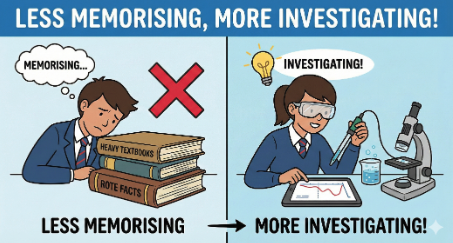
There are some fantastic changes to make learning Science less about memorising big words and more about thinking, investigating, and reasoning like a real scientist. Let’s break down the most important updates so you know exactly what to expect and how to ace the paper!
The Big 3 Changes to the Syllabus & Exam
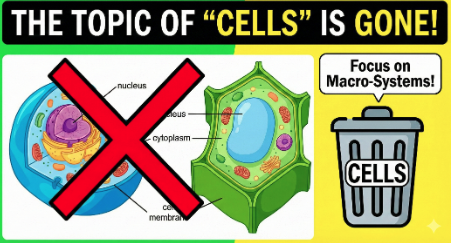
- The Topic of “Cells” is GONE!
That’s right! In the past, Primary 5 students had to memorise microscopic parts like the cytoplasm, nucleus, and cell membrane. MOE has completely removed the topic of Cells from the primary school syllabus.
- Why? The goal is to free up your time so you can focus deeply on macro-systems (like the human respiratory system and the water cycle) without being bogged down by complex terminology that is hard to visualize.
- (Parents: This is a huge relief! The P5 year used to cause a notorious “grade drop” due to content overload. This change makes the workload much more manageable.)
2. Booklet A is Heavier, with new “Linked MCQs”
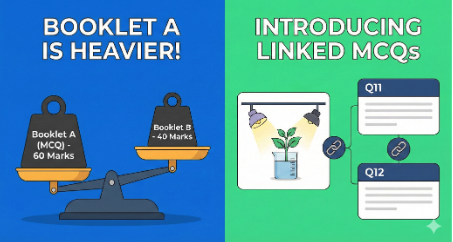
- Old Format: 28 MCQs (56 marks)
- New Format: 30 MCQs (60 marks)
Booklet A now holds 60% of your total grade!
But here is the big twist: the introduction of Linked MCQs. You will now see pairs of questions (like Q11 and Q12) that are based on the exact same experimental setup or story.
- Why? This tests your ability to focus deeply on one scenario and answer multiple angles about it, just like a scientist analyzing a single complex experiment in a lab.
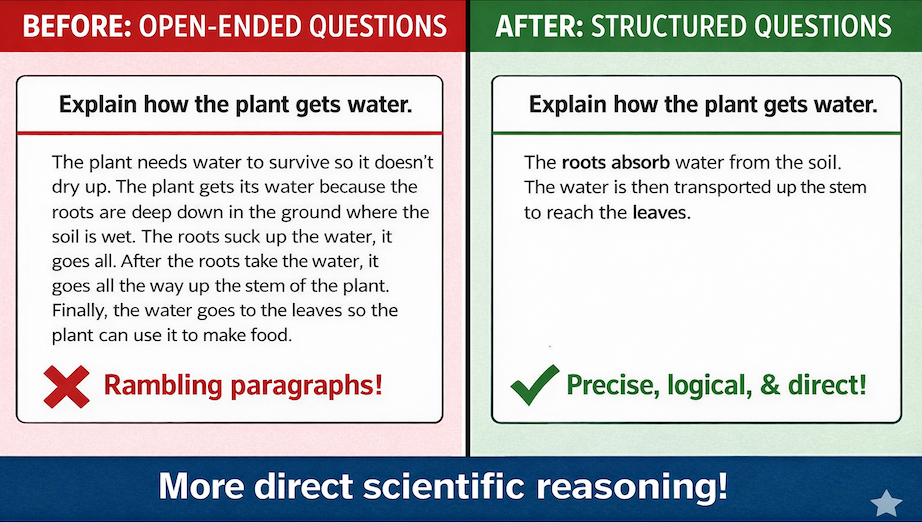
3. “Structured” Questions Replace “Open-Ended” Questions
- Old Format: 12-13 Open-ended questions (44 marks)
- New Format: 10-11 Structured questions (40 marks)
Booklet B has fewer questions and carries slightly fewer marks. More importantly, the questions are now called Structured instead of Open-ended. They don’t want you writing long, rambling paragraphs or worrying about perfect essay phrasing. They want precise, logical, and direct scientific reasoning.
Top Tips & Advice for Students and Parents
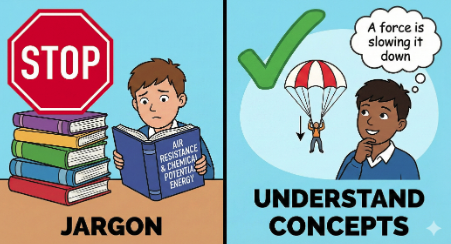
Stop Memorising Jargon!
The new syllabus specifically states that certain big words are not required anymore. For example, you don’t need to use terms like air resistance, water resistance, or chemical potential energy. Instead of memorising words, focus on understanding the concept (e.g. understanding that a force is slowing the parachute down, rather than just memorising the phrase air resistance).
Master the C-E-R Method for Booklet B
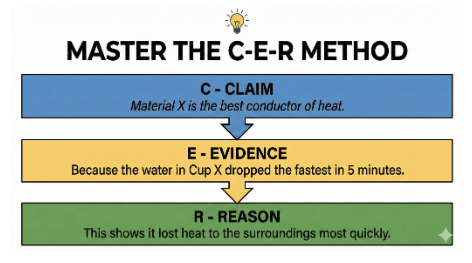
Since Booklet B questions are now “Structured,” you need a structured way to answer them to guarantee maximum marks. Always use the C-E-R technique:
- C – Claim: Answer the question directly (e.g. Material X is the best conductor of heat.).
- E – Evidence: Use data from the table or graph provided (e.g. Because the temperature of the water in Cup X dropped the fastest in 5 minutes…).
- R – Reason: Link it to a science concept (e.g. …which shows it lost heat to the surroundings most quickly.).
Watch Out for Experimental Design Question
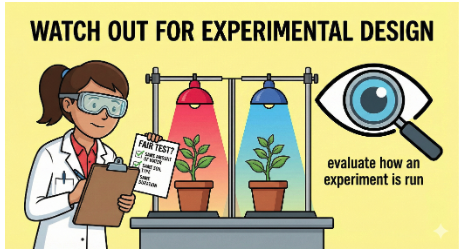
Expect a heavy focus on experiments. Examiners want to see if you can evaluate how an experiment is run. Always ask yourself these four questions when reading an exam scenario:
- What is the changed variable? (What are we testing?)
- What are the measured variables? (What are we recording or observing?)
- What are the constant variables? (What must stay the exact same to ensure a fair test?)
- What is the purpose of the control setup? (To prove that the changed variable is the only thing causing the result!)
Parents, encourage your child’s curiosity at home!
Ask them “Why?” and “How do you know?” when observing everyday things like water boiling, shadows changing length, or magnets sticking to the fridge.
The 2026 PSLE Science paper rewards students who can think critically, evaluate evidence, and apply concepts to brand-new situations.

You’ve got this, Class of 2026! Happy investigating!

Responses